Wednesday, 4 March 2009

HUU Elections 2009 - Polling days

Before I get onto the subject of this entry, I should point out that the current UST (Alex Hamilton) sent a message to me and said that as a result of my discovery about the confusing Returning Officer notices, the incorrect notice has been removed from Hullstudent.com. He has also informed me that there are plans to work on improving the mentions of the Election Appeals Committee in the relevant standing orders.

Anyway, at the time of typing, it's the second polling day of the elections at Hull University Union.

Physical presence

Oddly, the campaign teams were allowed to have a presence before the polling started. This is a strange decision by the union because anyone who talked to the campaign teams couldn't go and vote afterwards.

It was good to see that at least some of the teams were out there from early on though - it definitely shows committment. Unfortunately, I spoke to one candidate who said his campaign team had "slept in", which is incredibly lazy, unhelpful and shows a huge lack of support. Sure some people might have lectures during the day and, to be fair, they should be allowed to attend those. However, not everyone has lectures from 9-6, so they can be around some of the time. I suspect the candidate I spoke to will have had words with his team!

On the first polling day, there was a solid presence outside the Brynmor Jones Library. It is a massive improvement on last year, when large proportions of the teams only turned up on the final day. However, as it was the last opportunity for people to vote, you can understand why they all appeared!


One thing I saw that was disappointing was campaign team members hanging around where people were voting. There was two or three from one team and someone else who was quite close to voters trying to give them stickers. This is very much against the rules (Standing Order 2003, point 28(e)) and all candidates should have explained this to their teams (the standing order is issued at the procedural meeting to all candidates - points 15 and 25(a) of S.O. 2003). I know that at least one of the people in that area was (or still is) a Union Councillor, so that's even more disgraceful. Naturally, I reported this to the UST and as far as I know, he's going to put a notice up about that, which is better than nothing.

Gimmicks

Gimmicks are almost an ever-present part of student union elections across the country. They are meant to introduce a bit of fun because the theory is that many students think politics is boring. If politics is made interesting, then people maybe more likely to listen to what you have to say and vote for you. As you can see from the two pictures above, the gimmickry comes in a variety of forms and for some voters it does work. However, it's not for everyone.

I am not a fan of gimmicks in this context at all. Although they may get the occasional laugh, students want a student union that 'just works', provides enough services and represents them - basically good value for money. I'm not sure you can get that across by using an inflatable castle, shiny wigs or things like juggling. If anything, the latter could be a metaphor for not being able to stabilise finances - especially if you drop the juggling balls!

Tom Bramall, the Welfare Officer in 2008 for the University of Sheffield Students' Union, summed it up best by saying:
"So when your at the ballot box don't think who has the catchiest slogan or the most gimmicks, think - Who's going to represent my needs, my wants and help make my University life the best ever."
Publicity
In the HUU elections, you can use many forms of publicity, such as radio interviews, flyers, posters and stickers. They can have varying forms of success - especially the flyers and stickers. This is because your average student often feels hassled by the various campaign teams. The best strategy would be to say something short and concise, then if they're not interested, simply leave them alone. Forcing people to wear stickers doesn't exactly attract their vote. It might even stop them from voting altogether.

As for posters, there are a number of pitfalls here. The main one is too much text. When people walk by your poster, they are not going to want to read several paragraphs - especially if they are rushing to e.g. a lecture or a meeting. The best thing is short sentences or bullet points.

The next thing is coverage. There are two ways of doing this. One is to simply put lots of posters up everywhere. However, this only works if you have a large campaign team because when the posters go up, everyone is trying to get in front of you to grab a prime location. If you have a small team, you'd have to be very quick and determine which are the best spots first. These tend to be near the stairs or anything at eye level. Nobody is likely to kneel down to read a lot of text on a crowded piece of A4 (or A3).

The other way works if you have a small team. If there is already a large collection of posters in one area that are one colour and you have a poster that is substantially different, put in the middle of the large collection. As it is different, people will notice it. Once again, the stairs and anything at eye level is a good place to go. This method can also work if you have limited camapign funds.

When I was campaigning in 2006, I had a very small team (at times it was myself, but I did have two others who alternated). This made it difficult when putting up posters, but while everyone was concetrating on one area of the building, I rushed up to other areas and took full advantage of the empty space.


In the picture above, you will see that those posters aren't at eye-level. However, they can be seen when you're near the top of a nearby staircase. Providing the text is big enough, you might get away with that.

This year, I've noticed that some candidates haven't done any posters. This surprises me, but it might appeal to those voters who don't like how excessive postering makes the union look a mess (believe it or not there are restrictions on where you can put them - point 28 of S.O. 2003). However, this only works if the voters know who you are via other means. You also have to think that not everyone will have a detailed look at the nomination forms.

Summary and Conclusion
I think the physical presence of campaign teams this year has been very good. Poster coverage has been ok too, although some will suffer because they haven't put any up - either in the major locations or nowhere at all. I am also disappointed by the occasional bit of rule-breaking, but this often happens. Candidates really should remind their teams about the restrictions.

I'm not entirely sure about voter interest so far - I haven't seen crowds of potential voters surrounding people in brightly coloured t-shirts. Having said that, the best way to tell is when the voting figures are released. I'd also like to see what happens on the final polling day and whether activity picks up then.

So, what do you think?

Technorati tags: HUU, Student Unions, Election, Politics

Monday, 2 March 2009

HUU Elections 2009 – Candidates & Controversy

I haven’t posted since November last year. To be honest, I had lost the motivation to blog and I had other things that used up my time. Each of my posts take a while to research. Anyway, certain things have happened recently which have given me some motivation again.

The importance and history of elections
At Hull University Union, the elections are some of the most important things to happen in the academic year. Unfortunately, apathy is rampant in student unions. It is the job of the executive to effectively communicate the importance and to use more than one medium, which will increase the chances of the relevant information being seen. In the past at HUU, the percentage of students voting has been below 20% (most of the time it’s below 15%). It would be good if the percentage goes up each year. If you vote then there’s a greater chance of the best candidates getting elected.

Candidates
Once again, all of the major positions have candidates. However, it concerns me that some have only one candidate (e.g. VP Welfare). While this doesn’t necessarily mean the one candidate will be bad, having some competition is always better. In the VP Education category, only one person has any student rep experience (student reps being one of the things VP Ed is responsible for). This could be problematic as experience of the area can provide a better understanding of the role. However, previous elections have shown that a non-rep can get successfully elected (see the ‘08 VP AR results and the Richard Jackson victory).

I don’t like criticising an individual candidate, but I think one of the people attempting to become President is severely harming his chances by what he has written on his nomination form. The reasons for standing should be detailed and contain policy ideas, as well as information about relevant experience. However, he is not breaking rules set out the the standing order governing elections. It is up to the voting members to decide if this is acceptable.

Major discrepancy
As I have already mentioned, communication of relevant information is important. Unfortunately, I have noticed some problems in this area and it worries me greatly.

One of the most important people in any election is the Returning Officer. Point 4 of Standing Order 2003 states:

“The Returning Officer (RO) is to be appointed by the Union Executive Committee when elections are called and can be either a permanent member of Union Staff or an assigned National Union of Students RO. Notification of the appointment is to be posted by the General Manager’s Secretary on the elections board within forty eight hours.”

In the Election Handbook, it states the Returning Officer for this year is Kathryn Docherty, who is a member of staff at the NUS. However, if you go here, you will find that Paul Tatton (the Union General Manger) was chosen as the RO.

You will see in the above quote that the RO is announced on the election board. Fair enough – that name will have to be considered accurate. However, this confusion on hullstudent.com is likely to confuse many students as few will read right through the standing order to find out about the election board. The website would be a more obvious port of call.

The bigger notice that mentions Paul Tatton will probably be the one that students see first. This is because the point about Kathryn Docherty is hidden in the middle of one download and is not shown anywhere else. If it turns out that Paul Tatton is not the RO, then this demonstrates both a lack of transparency and clarity. In both cases, there are no details about how to contact those people. If people have a complaint or other issue, they might not know who to talk to.

Other issues
The previous point is probably the biggest problem in my opinion, but there other things that need to be mentioned that are related to clarity and transparency.

Point 7 of S.O. 2003 states what will happen if there is a serious or wilful breach of election procedures:

“If the RO has any doubts as to the eligibility of a candidate or considers that there has been a serious or wilful breach of election procedures then disqualification is mandatory.”

Later on in the document, point 25(a) mentions rules for campaign team members:

“Candidates are responsible for the behaviour of their team members during the election campaign. It is their responsibility to ensure that all of their campaign team are briefed on the rules and regulations surrounding elections. Candidates are all provided with Standing Orders governing elections and it is imperative that they relay this information to their teams and explain that many of the rules also apply to team members. If a complaint is made it will be referred to the RO who will then decide on the appropriate action to take, see 7.”

The above mentions that point 7 talks about appropriate action for the RO to take. However, that only talks about disqualification. Nowhere does point 7 mention the EAC (Election Appeals Committee) or what happens in the case of a minor issue.

This could be interpreted in two ways:

  1. It is simply badly worded and should say something like: “for an example of appropriate action, see point 7".
  2. The only appropriate action for any complaint is disqualification, but what if it’s only a minor issue? Where does the EAC fit into this?

This point needs to be much clearer.

During the elections, the Returning Officer can choose any number of Assistant Returning Officers (point 6 of S.O. 2003). There are also eligibility restrictions (they must be a full member of the union who is not a proposer or seconder). Looking at this point, it is perfectly possible for a part-time UEC member to be chosen or supporter who is neither a proposer or seconder.

This introduces an element of bias. There’s also nothing to suggest the names of AROs will be released. These points show a lack of detail and transparency.

Summary and Conclusion
The issues I have mentioned above have varying levels of importance, but I think it’s clear that a number of them relate to the role of the returning officer, as well as communicating in a clear and transparent fashion. The major problem is finding out exactly who the RO is and how to contact them. Other points can hopefully be addressed in the next iteration of S.O. 2003.

My next post will relate to the polling days and the post after that will be a general post-mortem of the whole election process.

So, what do you think? I welcome any comments from students, UEC members and anyone else who is interested.

Technorati tags: HUU, Student Unions, Elections, Politics, Governance

Wednesday, 5 November 2008

Obama 338 - 163 McCain


As you can see from the result above, the Illinois Senator Barack Obama was elected to be the next President of the United States. He will start that job on January 20th, 2009.

Results breakdown
Here is a graphical representation of who won each state:

Here is a simple breakdown of the numbers
ChoiceNo. states
Democrat28
GOP21
Incomplete2

The result above is about electoral college votes and that's what decided who won the states. Remember that the votes of the people don't count in the US, although it's expected that the members of the Electoral College assigned to each state will vote the way the people do. It hasn't always happened like that though (have a look at the results from the 2000 Gore vs. Bush election).

Big switch
One of the most interesting facts from this result is that nine states switched there support and in all cases it was from GOP (the Republicans) to Democrat. Those states included Florida, an important state in 2000 and has been Republican for a number of years. It was an area that Rudy Giuliani concentrated on heavily when he was campaigning.

What reasons could there be for the big switch in those nine states? Well, there are several possibilities. A campaign theme for McCain was based around fear (because of the terrorist attacks). Maybe Obama's message of hope was more appealing. The VP picks have been frequently analysed and maybe the gaffes of Sarah Palin were a factor.

Exit poll analysis
The exit polls on CNN reveal some interesting information about the way people voted. Some of it is stating the obvoius, but it's better when it's confirmed with numerical data.

It seems a large proportion of John McCain's votes came from the older white population. Obama dominated the young and non-white demographics. As an example, 55% of the white population voted for McCain and a spectacular 94% of African-Americans went for Obama. Another example is that McCain got 53% of the 65 and older demographic.

This goes to confirm that age and race still play a major part in the election. It's worrying, but not unexpected.

Speeches
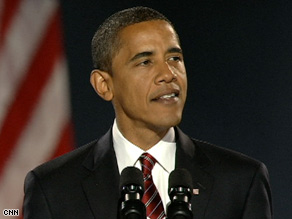
The following is Barack Obama's victory speech:


This is the sort of speech that Obama has been giving throughout the camapign. Although it is full of inspirational talk and essentially a message of hope and change, it doesn't give us anything new.

Lack of detail in speech
He doesn't go into specifics about all his policies either. A criticism of him has been that he hasn't done that thorughout his campaign. However, I believe he has - for example, he has a plan for improving national security freely available on his website and it contains budget figures, military numbers and deadlines. Also, he can give us more detail when he actually gets into the Whitehouse because then he'll have access to more information.

GOP defeat
John McCain was gracious in defeat, saying that he now hopes that America can move forward:
"This is an historic election, and I recognize the special significance it has for African-Americans and the special pride that must be theirs tonight"
"These are difficult times for our country. And I pledge to him tonight to do all in my power to help him lead us through the many challenges we face."
International recognition
There were many leaders who congratulated Obama on his victory - but then that's to be expected. They want to have good relationships with one of the most powerful nations on earth. It's something that's been done over many years. Here is what Gordon Brown had to say:
"I hope to be able to work with Senator Obama to bring the world together so that we can face these difficult times with more coordination and more unity than we've seen before."
Problems
It seemed to be a relatively smooth election day. The only problems that were reported mainly focused on long queues and faulty e-voting systems. The queues are unavoidable, but they could be minimised if more polling stations and voting booths were made available. It's a simple formula. The availability of voting machines cannot be based on the turnout of a previous election because it doesn't take into account the candidates and the current public feeling towards politics and other current affairs.

E-voting was something heavily criticised in previous elections and it is something that I've blogged about before, but providing more research and development is done, it can work.

Summary and conclusion
It has been a very long election process. Most people will agree that it has been too long. There needs to be some reform in this area soon. The scheduling of primaries needs to be worked on too - entire states were robbed of the delegates that would normally go to the party conventions where the presidential candidates are announced.

It has also been heavily money-driven. There were several stories in the media about campaign funding. Several people support the idea of a funding cap. It's something I agree with because if everyone has the same amount of money, it shifts the focus from finances and onto the important politics.

Despite all that, I believe a high calibre candidate has been elected as President and hopefully his promise of change will be reality during his tenure (whether it's four or eight years).

So, what do you think?

Technorati tags: Politics, US Election, John McCain, Barack Obama, Government,