Showing posts with label Politics. Show all posts

Friday, 13 March 2009

HUU Elections 2009 - The delayed President

One of the more controversial aspects of the elections that recently took place at Hull University Union was the disqualification of one of the Presidential candidates - Jamie Scudamore. Due to that decision, made by Returning Officer Kat Docherty, Jamie appealed and that meant an Election Appeals Committee had to be arranged. This delayed the result by a week.

Final round results
As the decision to disqualify Jamie Scudamore was reversed by the Election Appeals Committee, he has been elected President and all of the results from the polling period stand. R.O.N was out of the running first. In the next round Ben Hall and Rory Stobo were out of the running, which meant there was three candidates in the final round:

CandidateVotes
Jamie Scudamore1152
Amy Hopkinson655
Andrew Barrett471
Q&A with Alex Hamilton
Alex Hamilton
After the result of this particular election was announced, I had several questions. A number of rumours were being circulated and I wanted to make sure I had the truth before blogging anything. Yesterday I sent an email to Alex Hamilton (the UST and Deputy Returning Officer), containing the questions that I had and I got the following responses this morning:

Are the minutes of the EAC going to be published on hullstudent?
I'll have to check with Paul what the availability of closed committee minutes is. The reasons to go into closed session were the reports of what has happened previously in EACs, regarding intimidation of the EAC by the behaviour and amount of people present (Amy had arrived with about 15 very vocal supporters); also some of the evidence given would be prejudicial against one of the complainants if the EAC decided to re-run the election so it was deemed unsuitable to be heard publically.

Is it true that there was a 12-0 vote in favour of Jamie Scudamore winning, despite him breaking rules?
The vote was 10-0 as only ten could make the meeting (quoracy is seven). They decided that the infringements during the election that were dealt with to the RO’s satisfaction were not grounds to exclude him and that the only unresolved issue, the one for which the RO excluded the candidate was insubstantial, especially given the circumstances in which it was initiated.

Was the EAC called because he was canvassing (e.g. knocking on doors) in areas where he wasn't supposed to?
It was not. There has been a rumour of a local council byelaw prohibiting this, but no proof has been offered. I have myself researched this and the only thing I could find was a byelaw preventing the employment of children for door knocking/ canvassing without an adult present; which would of course imply that adults can do so.

There have been accusations of rigging (I'm not going to name anyone). Can I get your confirmation that it was completely random selection that decided who was part of the EAC?
I can confirm the students were entirely random, as the Chair of Council (Paddy) and James Brooks can attest to.

The process I used to select the students was http://random.org/integers/ to generate 200 random positive integers, these numbers then corresponded to a cell on an excel spreadsheet of all students, which has them listed 1-17000ish. These names were then checked against the list of candidates, proposers and seconders. I then sent an email to these students explaining the situation (an appeal had been made which required adjudication). I also checked the respondents’ facebooks for any campaign ties, and then found a time that at least 7 could make to hold the meeting. I also did not know any of the EAC.

I must also point out that I refused to release the names of the EAC prior to the meeting, despite threats of a motion of no-confidence against myself (which was subsequently made) from Amy’s campaign team, notably Sam Greenwood.


What are your thoughts on the decision of the EAC to elect Jamie?
I am of course impartial to any proceedings during the election period. I am satisfied though that the EAC carried out their duty satisfactorily and professionally.

Alex finished off the email by stating:
"There have been a great deal of rumours surrounding the President election (as there are almost every year), this year I feel the difference is that two actively political campaigns have not succeeded against what is seen as an outsider to HUU politics, and due to the last minute resignation of the previous RO, a Sabbatical needing to take on the deputy duties, as I am available on campus during the period – as a result the parties involved moved their attentions from campaigning for a victory to undermining the processes involved.

The recently elected Officers have a massive democratic mandate as a result of our highest ever turnout, and as such it is a shame that some groups within our democratic structures are intent on ignoring and undermining this."
First of all I have to thank Alex for taking the time to answer the questions. It would have been easy to ignore them and keep speculation circulating around the union.

Despite the detail of these responses, I still have some concerns. Kat Docherty was only present on the results night and there is no evidence to suggest she was present at the EAC to justify her decision. His refusal to release the names of the EAC is also worrying.

There is only his word which states the membership wasn't rigged in any way. This doesn't help to make the union transparent and also means there is nothing to prove that what he says about committee selection is correct. In the past, I have seen EAC membership announced and it's even more important given that there's a no-confidence motion against him.

In point 3, he stated that he could not find evidence to prove that the accusation about canvassing was against the rules. After searching election laws, Standing Order 2003 (governing elections) and the HUU Bye-laws I could not find anything either. If there is proof - then please leave a comment on this blog post.

If there's no proof of that though, what was the reason for the initial disqualification? This needs to be stated to make sure the union remains transparent.

Alex also mentioned the subject of the previous RO (Paul Tatton), resigning from that position. Even though Alex felt an impartial replacement needed to be found, this does not mean that he should necessarily be the automatic choice as a deputy. As I have stated in a previous blog post, theoretically he could influence the result and (as he rightly states), executive officers are meant to be impartial.

Public opinion
I have asked other people what they feel about the decision to elect a candidate who was initially disqualified. One person said:
"I think its right
There is no way you can say that the number of votes cast has been dramatically affected by what happened.
His vote count was far too high for that."
I replied by stating that "while it's true that there is no proof that the two things are linked, is it right that a person who was initially disqualified should be elected?". The person said:
"i still feel it was in the best interests of the students and the union itself"
It is an interesting point. Not being able to found out who can rightly call themselves President as soon as possible can have a huge impact. It affects training schedules, teamwork and could potentially mean voters lose faith in the union's ability to manage itself properly.

However, it is important that those who are elected have the right to hold that position and all necessary steps need to be taken to ensure that.

Summary and Conclusion
I would say that the biggest problem is communication. As I have mentioned, there is evidence of a lack of transparency and people need this to know that their votes have meaning. There needs to be appropriate publicity for all elections and all info that is published needs to be 100% accurate.

The presidential election could have been handled better, but I applaud Alex for giving answers to important questions in an effort to reduce the number of concerns people have. If you have any issues with the election, it is always important to contact the RO or the deputy.

It will be interesting to hear what happens with the no-confidence motion. There seems to be a large amount of support for it, but will people give up as the election process is now completed?

So, what do you think?

Technorati tags: Election, HUU, Politics, Student Unions, President

Friday, 6 March 2009

HUU Elections 2009 - the results (with a twist)

The last day of voting and the announcement of the results were both very eventful. Naturally, there was a lot of tension and when each result was announced, there was a huge amount of emotion shown. Amongst the chanting and the tears though, we now have most of the team that will be in charge of the union for the 09/10 academic year.

A note about the presidential election
The following quote is from a statement made by Kat Docherty, the returning officer for this year (the full statement can be found here):
"During the course of the elections, a number of complaints were received by the Returning Officer regarding a particular candidate for the position of President. Some of these complaints were upheld and the decision made to exclude the candidate from the elections."
The disqualified candidate (several reliable sources told me it was Jamie Scudamore), has appealed the decision and there will be an Election Appeals Committee meeting that decides who becomes President next year. As a result of this I will be posting the result of the Presidential election in an extra (fourth) entry about the elections.

The results
VP Welfare
CandidateVotes
Alice Marshall910
R.O.N.318

VP Community (final round results)
CandidateVotes
Ben Wilcox681
Katie Beth-Hardy350
Andrew Corless331

VP Education (final round results)
CandidateVotes
Chris Marks530
Mark Tyson398

VP Sports (final round results)
CandidateVotes
James 'Wayne' Kerr930
Nathan Webster921

Chair Scarborough
CandidateVotes
Darius Navickas249
James Nicholson221

Chair ISA
CandidateVotes
Line Kristensen543
Joe Kitanosono156
R.O.N.69

Chair Media Committee
CandidateVotes
William Langdale518
R.O.N.207

Chair Campaigns & Democracy
CandidateVotes
Basit Mohammed530
Kaveh Azarhoosh409

Other winners
There were several other positions up for grabs during the elections. One very intersting election was for the position of Chair RAG. In the final round, Ellen Hinsley won by just two votes. It's also interesting to note that after the first round she was only leading by three.

Some of the other elections only had one human candidate and the Re-open nominations option, so it was almost certain who would win that. For example, that happened in the case of Disabled Students Chair (won by Stephen Lee), the Male Chair of LGBT (won by Daniel Horner) and the Chair of the Mature Students Committee (won by Luke Howard-Pask).

Comments on the results
I find the result for the VP Education election very interesting. Chris Marks has managed to repeat what Richard Jackson did in last year's elections by winning despite having no experience of the area he's going to be in charge of. Hopefully, the students thought his policies were good enough. I also have to mention that Mark Tyson wasn't helped by his campaign team being absent most of the time. I have mentioned in a previous post that this was disgraceful. If you don't have a noticeable physical presence at election time, you're going to be disadvantaged.

The VP Sport election was incredibly tight (nine vote difference). I think that has to be one of the closest results for a full-time officer position in a number of years.


The picture above shows Nathan Webster (runner-up in the VP Sport election) doing some karaoke with some of the winners (I have to point out that the choice of song was incredibly clichéd), which shows in most cases, elections were cleanly fought and people were friends afterwards - which is nice to see. It's just things like the presidential election which casts a shadow over everything.

Voter turnout/apathy
This was something that really impressed me. The turnout was 3087 and that is a 58% increase on the previous. Congratulations have to go to the union for improving it by that much. The biggest change to the voting setup was using the university portal as a login method, so I assume the decision to use that helped improve the turnout.

Another important figue is what the turnout is as a percentage of the total student population. According to the university website, the number of student scurrently stands at 19,818. Assuming that there were no people who opted out of union membership, that means 15.58% of students voted.

While that is still an impressive figure both compared to previous years and compared to other unions, it still means that the majority of students didn't vote. It means that next year's UEC still have work to do. However, it is always hard to get rid of student apathy. I can't see anything like 90% turnouts anytime soon.

Summary and Conclusion
This election has been 'mixed', to say the least. While most elections have been fought cleanly, things like the presidential election have caused considerable controversy and tarnished the outcome. The turnout was great. Also, many candidates performed well, despite not having that many posters or a physical presence.

Another thing to note is R.O.N. Although in some cases that option was removed in the first round, a surprising number of people voted for it. That has both positives and negatives. It means that more people are willing to engage with the political process, but it also means that they are prepared to delay things. Having said that, if it means the best person gets chosen for the job - it's a good thing.

So, what do you think?

Technorati tags: HUU, Student Unions, Election, Politics

Wednesday, 4 March 2009

HUU Elections 2009 - Polling days

Before I get onto the subject of this entry, I should point out that the current UST (Alex Hamilton) sent a message to me and said that as a result of my discovery about the confusing Returning Officer notices, the incorrect notice has been removed from Hullstudent.com. He has also informed me that there are plans to work on improving the mentions of the Election Appeals Committee in the relevant standing orders.

Anyway, at the time of typing, it's the second polling day of the elections at Hull University Union.

Physical presence

Oddly, the campaign teams were allowed to have a presence before the polling started. This is a strange decision by the union because anyone who talked to the campaign teams couldn't go and vote afterwards.

It was good to see that at least some of the teams were out there from early on though - it definitely shows committment. Unfortunately, I spoke to one candidate who said his campaign team had "slept in", which is incredibly lazy, unhelpful and shows a huge lack of support. Sure some people might have lectures during the day and, to be fair, they should be allowed to attend those. However, not everyone has lectures from 9-6, so they can be around some of the time. I suspect the candidate I spoke to will have had words with his team!

On the first polling day, there was a solid presence outside the Brynmor Jones Library. It is a massive improvement on last year, when large proportions of the teams only turned up on the final day. However, as it was the last opportunity for people to vote, you can understand why they all appeared!


One thing I saw that was disappointing was campaign team members hanging around where people were voting. There was two or three from one team and someone else who was quite close to voters trying to give them stickers. This is very much against the rules (Standing Order 2003, point 28(e)) and all candidates should have explained this to their teams (the standing order is issued at the procedural meeting to all candidates - points 15 and 25(a) of S.O. 2003). I know that at least one of the people in that area was (or still is) a Union Councillor, so that's even more disgraceful. Naturally, I reported this to the UST and as far as I know, he's going to put a notice up about that, which is better than nothing.

Gimmicks

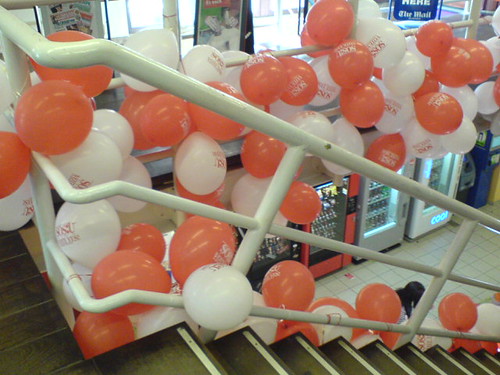
Gimmicks are almost an ever-present part of student union elections across the country. They are meant to introduce a bit of fun because the theory is that many students think politics is boring. If politics is made interesting, then people maybe more likely to listen to what you have to say and vote for you. As you can see from the two pictures above, the gimmickry comes in a variety of forms and for some voters it does work. However, it's not for everyone.

I am not a fan of gimmicks in this context at all. Although they may get the occasional laugh, students want a student union that 'just works', provides enough services and represents them - basically good value for money. I'm not sure you can get that across by using an inflatable castle, shiny wigs or things like juggling. If anything, the latter could be a metaphor for not being able to stabilise finances - especially if you drop the juggling balls!

Tom Bramall, the Welfare Officer in 2008 for the University of Sheffield Students' Union, summed it up best by saying:
"So when your at the ballot box don't think who has the catchiest slogan or the most gimmicks, think - Who's going to represent my needs, my wants and help make my University life the best ever."
Publicity
In the HUU elections, you can use many forms of publicity, such as radio interviews, flyers, posters and stickers. They can have varying forms of success - especially the flyers and stickers. This is because your average student often feels hassled by the various campaign teams. The best strategy would be to say something short and concise, then if they're not interested, simply leave them alone. Forcing people to wear stickers doesn't exactly attract their vote. It might even stop them from voting altogether.

As for posters, there are a number of pitfalls here. The main one is too much text. When people walk by your poster, they are not going to want to read several paragraphs - especially if they are rushing to e.g. a lecture or a meeting. The best thing is short sentences or bullet points.

The next thing is coverage. There are two ways of doing this. One is to simply put lots of posters up everywhere. However, this only works if you have a large campaign team because when the posters go up, everyone is trying to get in front of you to grab a prime location. If you have a small team, you'd have to be very quick and determine which are the best spots first. These tend to be near the stairs or anything at eye level. Nobody is likely to kneel down to read a lot of text on a crowded piece of A4 (or A3).

The other way works if you have a small team. If there is already a large collection of posters in one area that are one colour and you have a poster that is substantially different, put in the middle of the large collection. As it is different, people will notice it. Once again, the stairs and anything at eye level is a good place to go. This method can also work if you have limited camapign funds.

When I was campaigning in 2006, I had a very small team (at times it was myself, but I did have two others who alternated). This made it difficult when putting up posters, but while everyone was concetrating on one area of the building, I rushed up to other areas and took full advantage of the empty space.


In the picture above, you will see that those posters aren't at eye-level. However, they can be seen when you're near the top of a nearby staircase. Providing the text is big enough, you might get away with that.

This year, I've noticed that some candidates haven't done any posters. This surprises me, but it might appeal to those voters who don't like how excessive postering makes the union look a mess (believe it or not there are restrictions on where you can put them - point 28 of S.O. 2003). However, this only works if the voters know who you are via other means. You also have to think that not everyone will have a detailed look at the nomination forms.

Summary and Conclusion
I think the physical presence of campaign teams this year has been very good. Poster coverage has been ok too, although some will suffer because they haven't put any up - either in the major locations or nowhere at all. I am also disappointed by the occasional bit of rule-breaking, but this often happens. Candidates really should remind their teams about the restrictions.

I'm not entirely sure about voter interest so far - I haven't seen crowds of potential voters surrounding people in brightly coloured t-shirts. Having said that, the best way to tell is when the voting figures are released. I'd also like to see what happens on the final polling day and whether activity picks up then.

So, what do you think?

Technorati tags: HUU, Student Unions, Election, Politics

Monday, 2 March 2009

HUU Elections 2009 – Candidates & Controversy

I haven’t posted since November last year. To be honest, I had lost the motivation to blog and I had other things that used up my time. Each of my posts take a while to research. Anyway, certain things have happened recently which have given me some motivation again.

The importance and history of elections
At Hull University Union, the elections are some of the most important things to happen in the academic year. Unfortunately, apathy is rampant in student unions. It is the job of the executive to effectively communicate the importance and to use more than one medium, which will increase the chances of the relevant information being seen. In the past at HUU, the percentage of students voting has been below 20% (most of the time it’s below 15%). It would be good if the percentage goes up each year. If you vote then there’s a greater chance of the best candidates getting elected.

Candidates
Once again, all of the major positions have candidates. However, it concerns me that some have only one candidate (e.g. VP Welfare). While this doesn’t necessarily mean the one candidate will be bad, having some competition is always better. In the VP Education category, only one person has any student rep experience (student reps being one of the things VP Ed is responsible for). This could be problematic as experience of the area can provide a better understanding of the role. However, previous elections have shown that a non-rep can get successfully elected (see the ‘08 VP AR results and the Richard Jackson victory).

I don’t like criticising an individual candidate, but I think one of the people attempting to become President is severely harming his chances by what he has written on his nomination form. The reasons for standing should be detailed and contain policy ideas, as well as information about relevant experience. However, he is not breaking rules set out the the standing order governing elections. It is up to the voting members to decide if this is acceptable.

Major discrepancy
As I have already mentioned, communication of relevant information is important. Unfortunately, I have noticed some problems in this area and it worries me greatly.

One of the most important people in any election is the Returning Officer. Point 4 of Standing Order 2003 states:

“The Returning Officer (RO) is to be appointed by the Union Executive Committee when elections are called and can be either a permanent member of Union Staff or an assigned National Union of Students RO. Notification of the appointment is to be posted by the General Manager’s Secretary on the elections board within forty eight hours.”

In the Election Handbook, it states the Returning Officer for this year is Kathryn Docherty, who is a member of staff at the NUS. However, if you go here, you will find that Paul Tatton (the Union General Manger) was chosen as the RO.

You will see in the above quote that the RO is announced on the election board. Fair enough – that name will have to be considered accurate. However, this confusion on hullstudent.com is likely to confuse many students as few will read right through the standing order to find out about the election board. The website would be a more obvious port of call.

The bigger notice that mentions Paul Tatton will probably be the one that students see first. This is because the point about Kathryn Docherty is hidden in the middle of one download and is not shown anywhere else. If it turns out that Paul Tatton is not the RO, then this demonstrates both a lack of transparency and clarity. In both cases, there are no details about how to contact those people. If people have a complaint or other issue, they might not know who to talk to.

Other issues
The previous point is probably the biggest problem in my opinion, but there other things that need to be mentioned that are related to clarity and transparency.

Point 7 of S.O. 2003 states what will happen if there is a serious or wilful breach of election procedures:

“If the RO has any doubts as to the eligibility of a candidate or considers that there has been a serious or wilful breach of election procedures then disqualification is mandatory.”

Later on in the document, point 25(a) mentions rules for campaign team members:

“Candidates are responsible for the behaviour of their team members during the election campaign. It is their responsibility to ensure that all of their campaign team are briefed on the rules and regulations surrounding elections. Candidates are all provided with Standing Orders governing elections and it is imperative that they relay this information to their teams and explain that many of the rules also apply to team members. If a complaint is made it will be referred to the RO who will then decide on the appropriate action to take, see 7.”

The above mentions that point 7 talks about appropriate action for the RO to take. However, that only talks about disqualification. Nowhere does point 7 mention the EAC (Election Appeals Committee) or what happens in the case of a minor issue.

This could be interpreted in two ways:

  1. It is simply badly worded and should say something like: “for an example of appropriate action, see point 7".
  2. The only appropriate action for any complaint is disqualification, but what if it’s only a minor issue? Where does the EAC fit into this?

This point needs to be much clearer.

During the elections, the Returning Officer can choose any number of Assistant Returning Officers (point 6 of S.O. 2003). There are also eligibility restrictions (they must be a full member of the union who is not a proposer or seconder). Looking at this point, it is perfectly possible for a part-time UEC member to be chosen or supporter who is neither a proposer or seconder.

This introduces an element of bias. There’s also nothing to suggest the names of AROs will be released. These points show a lack of detail and transparency.

Summary and Conclusion
The issues I have mentioned above have varying levels of importance, but I think it’s clear that a number of them relate to the role of the returning officer, as well as communicating in a clear and transparent fashion. The major problem is finding out exactly who the RO is and how to contact them. Other points can hopefully be addressed in the next iteration of S.O. 2003.

My next post will relate to the polling days and the post after that will be a general post-mortem of the whole election process.

So, what do you think? I welcome any comments from students, UEC members and anyone else who is interested.

Technorati tags: HUU, Student Unions, Elections, Politics, Governance

Wednesday, 5 November 2008

Obama 338 - 163 McCain


As you can see from the result above, the Illinois Senator Barack Obama was elected to be the next President of the United States. He will start that job on January 20th, 2009.

Results breakdown
Here is a graphical representation of who won each state:

Here is a simple breakdown of the numbers
ChoiceNo. states
Democrat28
GOP21
Incomplete2

The result above is about electoral college votes and that's what decided who won the states. Remember that the votes of the people don't count in the US, although it's expected that the members of the Electoral College assigned to each state will vote the way the people do. It hasn't always happened like that though (have a look at the results from the 2000 Gore vs. Bush election).

Big switch
One of the most interesting facts from this result is that nine states switched there support and in all cases it was from GOP (the Republicans) to Democrat. Those states included Florida, an important state in 2000 and has been Republican for a number of years. It was an area that Rudy Giuliani concentrated on heavily when he was campaigning.

What reasons could there be for the big switch in those nine states? Well, there are several possibilities. A campaign theme for McCain was based around fear (because of the terrorist attacks). Maybe Obama's message of hope was more appealing. The VP picks have been frequently analysed and maybe the gaffes of Sarah Palin were a factor.

Exit poll analysis
The exit polls on CNN reveal some interesting information about the way people voted. Some of it is stating the obvoius, but it's better when it's confirmed with numerical data.

It seems a large proportion of John McCain's votes came from the older white population. Obama dominated the young and non-white demographics. As an example, 55% of the white population voted for McCain and a spectacular 94% of African-Americans went for Obama. Another example is that McCain got 53% of the 65 and older demographic.

This goes to confirm that age and race still play a major part in the election. It's worrying, but not unexpected.

Speeches
The following is Barack Obama's victory speech:


This is the sort of speech that Obama has been giving throughout the camapign. Although it is full of inspirational talk and essentially a message of hope and change, it doesn't give us anything new.

Lack of detail in speech
He doesn't go into specifics about all his policies either. A criticism of him has been that he hasn't done that thorughout his campaign. However, I believe he has - for example, he has a plan for improving national security freely available on his website and it contains budget figures, military numbers and deadlines. Also, he can give us more detail when he actually gets into the Whitehouse because then he'll have access to more information.

GOP defeat
John McCain was gracious in defeat, saying that he now hopes that America can move forward:
"This is an historic election, and I recognize the special significance it has for African-Americans and the special pride that must be theirs tonight"
"These are difficult times for our country. And I pledge to him tonight to do all in my power to help him lead us through the many challenges we face."
International recognition
There were many leaders who congratulated Obama on his victory - but then that's to be expected. They want to have good relationships with one of the most powerful nations on earth. It's something that's been done over many years. Here is what Gordon Brown had to say:
"I hope to be able to work with Senator Obama to bring the world together so that we can face these difficult times with more coordination and more unity than we've seen before."
Problems
It seemed to be a relatively smooth election day. The only problems that were reported mainly focused on long queues and faulty e-voting systems. The queues are unavoidable, but they could be minimised if more polling stations and voting booths were made available. It's a simple formula. The availability of voting machines cannot be based on the turnout of a previous election because it doesn't take into account the candidates and the current public feeling towards politics and other current affairs.

E-voting was something heavily criticised in previous elections and it is something that I've blogged about before, but providing more research and development is done, it can work.

Summary and conclusion
It has been a very long election process. Most people will agree that it has been too long. There needs to be some reform in this area soon. The scheduling of primaries needs to be worked on too - entire states were robbed of the delegates that would normally go to the party conventions where the presidential candidates are announced.

It has also been heavily money-driven. There were several stories in the media about campaign funding. Several people support the idea of a funding cap. It's something I agree with because if everyone has the same amount of money, it shifts the focus from finances and onto the important politics.

Despite all that, I believe a high calibre candidate has been elected as President and hopefully his promise of change will be reality during his tenure (whether it's four or eight years).

So, what do you think?

Technorati tags: Politics, US Election, John McCain, Barack Obama, Government,

Monday, 20 October 2008

All the excitement of a governance review

I won't bore you with the reasons why I haven't blogged much recently. I could have posted my opinions on the credit crunch or the latest news about the US election, but I'm not going to today - that will come later. This post is more of a continuation of my last post as it's about HUU's latest governance review.

The last post analysed the draft constitution when it was at it's green paper stage. Now it's after the white paper stage and it's time for a referendum - the point where the student population gets to decide whether the document is acceptable.

Publicity
I have to admit that the publicity for the voting period has been superb. There's been balloons, flyers, posters, information on HUU's website and more. Some people might say that it's too much (too many posters was often a complaint in previous sabbatical elections) however, you cannot say that they haven't made people aware that something is happening. There was a budget of £5k for this campaign though (see minutes of the UEC meeting from August 20th).


There is a couple of things wrong with the publicity though. Firstly, they don't have the details of how to vote on the flyers (e.g. website). A big ommission, especially considering not everyone goes on the union's website regularly.

Secondly, everything says 'vote yes'. This is a classic psychological tactic that used in the NUS and used by a number of factions within the student movement. It plants a thought in the mind of the student populus that there is only one option, when there's clearly two. The whole point of having a vote is allowing students to make their own decision. The union should present their proposed documents alongside the facts and the history of the governance review. If the UEC were right, then it's quite possible that the students could vote yes without needing their choice forced.

The final point about publicity is fairly serious. Considering there is a substantial budget for this, it would be sensible for large expenses to be approved by UEC. In the minutes of the UEC meeting from September 23rd, there is this in the President's report:
"Have ordered the 'year of change' banner to go across the entrance to the Union. Apologies to all members of UEC for ordering this without approval and not consulting on the cost. Hope to have the banner up for Welcome Week."
Helen apologised for the oversight, but it's still a significant expense and it has a message that was not approved by the UEC. It sets a dangerous precedent.

Draft Constitution - Part 1
The first issue in this part of the constitution is in point 2 ('The Name'). It states:
"The Association’s name is Hull University Union."
Currently, the student union is an un-incorporated association, but under the new constitution it will be a registered charity. Surely it should read 'The charity's name is Hull University Union'.

The next problem is in point 3 ('Objects of the student union'). These are included to tell you the union's reason for existing. They have to feature in the list of charitable objectives in the Charities Act. This is from the union's proposed constitution:
"The objects of the Students’ Union are:

1.1. The purpose of Hull University Union is the advancement of Education of students at the University of Hull.
1.2. It will achieve this by:
  • 1.2.1. Promoting the interests and welfare of students at the University of Hull during their course of study and representing, supporting and advising members.
  • 1.2.2. Being the recognised representative channel between students and the University and any other external bodies.
  • 1.2.3. Providing cultural, sporting and recreational activities, opportunities to volunteer in the community and forums for discussion and debate for the personal development of its members."
For an official document, this is incredibly poor layout and could easily be misinterpreted. According to that section, the union can advance the quality of education at the university by providing such things as sporting and cultural activities. That makes no sense. Sport is an object separate to education.

In point 4 ('Application of Income and Property'), sub-clause 3 places restrictions on what money/remunaration can be given to members (for instance, no income or property of nthe charity can be given to a member) unless it's a reimbursement for a product or service. However, sub-clause 8 conflicts with that by stating that a trustee can receive a benefit not permitted in sub-clause 3 providing they declare interest, do not attend relevant meetings and do not vote.

Draft Constitution - part 2
In the section aout membership, it lists the various different types of membership for the student union:
  • Full members
  • Honorary Life members
  • Life members
  • Reciprocal members
  • Associate members
  • Temporary members
It also provides detailed information about your rights as a full member. However, there's no part of the constitution that gives information about the other types of membership.

The next point refers to Union Extraordinary General Meetings. The Board of Trustees, UEC or 100 full members can convene an EGM. Is 100 members enough peopleconsidering there are several thousand members in total? I can only assume that it's this number due to the apathy that exists amongst the members of the union. The problem is, this could lead to minority rule. A larger number is required, but nothing like e.g. 40%, because that is just ridiculous.

In the point about the board of trustees, it states that trustees must keep minutes of meetings. Wouldn't it be better if an actual secretary did this and sent the minutes to the trustees afterwards? It would ensure consistency.

Ten committments
From the UEC meeting on the June 3rd (i.e. last academic year when Ed Marsh was the President), the following committments were agreed and would form part of the new constitution:
  1. Week 2, semester 2 council and open policy forum to be held in Scarborough
  2. the removal of VP SC will be reviewed against bench marks after 2 years
  3. all committee's must be run with representatives from both campus's, e.g. Women's, Societies and Media
  4. Union Manager Scarborough to keep a record of Sabbatical Officer attendance in Scarborough, to be presented at Council in week 12
  5. creation of Video Conferencing Facilities in both Unions
  6. president to hold 2 open forums a semester in Scarborough
  7. part Time officers to visit Scarborough twice a semester
  8. to run a Scarborough Specific Marketing Campaign aimed at explaining that Scarborough students can run for cross campus positions from President to A.U Council rep on union council
  9. to safeguard the recognition of Scarborough’s individuality by ring fencing its proportion of representation for 6 years
  10. to ring fence the wages of the VP SC for 5 years, so if it is reintroduced by UEC the required funding will be available
Under the consitution that is being put to referendum, Open Policy Forums no longer exist (despite it being implied that their existence is set in stone according to the UEC minutes from September 4th). Instead, there will be a one-per-term General meeting. There is no information about whether the committments relating to OPFs would be applied to this new meeting.

There is also no follow-up information in the UEC minutes about whether point 2 will still be happening. The same applies to points about finance. Also, will any general meetings, Zone meeting, EGMs or AGMs take place in Scarborough? If this is to be explained in the standing orders, fair enough. However, standing orders should already be available for viewing on the governance review pages of hullstudent.com. They are governance documents and I presume new versions will be written.

Summary and Conclusion
The constitution that is being voted on contains sections that are poorly laid out and could be easily misinterpreted. The section about money for trustees contains a potential loophole and the publicity is highly visible, but has a message which almost forces a particular choice from the students. Parts of the publicity are not approved either and some key details have been missed off.

All that, plus the fact that some pledges agreed last year have not been included in the new constitution. Unfortunately, the proposed documents cannot be altered now as it's part way through the voting period and it would mean voiding the votes that have already been cast.

So, what do you think?

Technorati tags: Student Unions, Politics, Governance

Monday, 12 May 2008

The HUU Governance Review

This year, after a referendum at HUU, a review of the current governance structures has been initiated. It's the second one in three years and it attempts to correct any flaws in the existing setup that was created to make the union more compliant with charity laws. At the time of typing, the green paper has been available for a few days and this post serves as a critical analysis of it.

Membership of the UEC
Currently, there are 10 members of the Union Executive Committee (7 full-time, three part-time). The part-time officers (UEOs) were a recent addition in the previous governance review. See the bottom of this page for more information. In the green paper, the following is proposed:
  • President
  • VP Community
  • VP Education
  • VP Sport
  • VP Welfare
  • Chair Scarborough Executive Committee (part-time)
There would also be the non-exec positions of Campaigns & Democracy Officer, Chair ISA, Media Officer and Societies Officer. A clear benefit of this will be the fact that meetings will be quicker. However, I think there are some problems with it.

You will notice that there is no Treasurer position on the committee, something which has been present in various forms over a number of years. The green paper states that the responsibility will be given to an external trustee. According to a source in the union, the reasons for this are:
"The charity is too complicated for anyone but an expert to understand the complicated finances"
Another reason was that it's often the case that the UST doesn't have a finance-related degree, so if the Finance Manager isn't doing his job properly, he may not notice.

During the training period for new sabbaticals, all members of the exec are given budget/finance training and there is also a presentation from Cazenove, which is the investment group HUU work with. In the handover time the present UST gives the successor information and advice about this area. The General Manager also gives comprehensive information and resources relating to charities. All that, as well as the self-learning you're expected to do, should mean that the UST would be prepared to do the job. Providing that the UST is doing their job properly, they should also be able to notice if the Finance Manager is not doing their job properly. If there is some uncertainty, you could always talk to the GM about it.

If the responsibility is given to an external trustee, it means there isn't anyone with that responsibility on the exec to give relevant reports. The external trustees aren't there all the time, so how can they do the job that the UST currently has?

Democracy
I can understand why Campaigns and Democracy is a part-time position in this proposed structure. The UST used to have responsibility for societies, but that's under the remit of VP Media & Volunteering at the moment. The new proposals also take away the treasurer responsibilities, so they obviously feel there's not enough left to justify a full-time position. However, it would mean there is no-one on the executive who is responsible for ensuring there's a democratic union. There's many elections to co-ordinate and the perennial task of battling against the dreaded student apathy. Whether this is a full-time position or not, I think it deserves a position on the exec.

Scarborough
I can forsee the decisions about Scarborough causing big problems. I'm not sure how many people would like the fact that the Scarborough exec chair would lose VP status and not be full-time. To some people, 'Chair' doesn't sound as important as 'Vice-President'. Scarborough is a big responsibility and previous VPs of that campus have shown that they have a large amount of work to do. Could a part-timer cope with that whilst doing their degree?

This could be an attempt to strengthen the Two campuses, one union image though. If the rest of the exec spend more time at the Scarborough campus, the workload could be shared. However, there is also the issues affecting the Hull campus and the union as a whole to take care of - would this be too much for the other positions?

Education
The green paper states that the VP (Academic Representation) would be called VP Education. I think this is a good decision because many other unions across the country (for example, Surrey SU and Loughborough SU). Apart from this and the inclusion of the zones, there doesn't seem to be a great deal of changes.

The exec might want to look at the committee lists to see if they're accurate. For example, I notice they made some valid changes to the VP Education committee list (which I recognise from Standing Order 3.001 that I rewrote), but there are still some inaccuracies (Graduate Research Committee is now called the Research Degrees Committee and there is no inclusion of the Library User Group, Free Electives Panel or Widening Participation Committee).

VP Community
The current role of Chair HUSSO is part-time, but the changes stated in this paper would mean that student community action would have a full-time officer again and more time can be given to making this valuable area of the union even better.

Meeting times
"The UEC shall meet in weeks 1, 4, 6, 8 and 10 of each semester. Meetings shall also occur outside of term-time as and when they are required"
This has the potential to be good for the increased number of part-time officers as it reduces their workload slightly. However, fewer meetings could mean that the executive is less responsive in certain situations. Remember, if there isn't enough to justify a meeting at some point, then it could always be cancelled.

Zones
This is a similar model to the one that the NUS use. I can see some students thinking that this is easier to find who is responsible for certain areas, but I see it as too many layers. You would have the zone committees who each decide on a policy that will be submitted to an Open Policy Forum. The OPFs decide which policy ideas go to a referendum (this is noted at Union Council). Too many layers means too much bureaucracy and additional paperwork.

The point about only one policy from each zone going to an OPF is a serious one. What if there is more than one vitally important policy that needs to be pushed through? It means one would have to be either abandoned or delayed until the next Zone committee. This could cause severe delays in the improvement of the union.

Open Policy Forums
The following is from the green paper:
"The OPF to Referenda process will run independently of the governance structures of HUU..."
This is total nonsense. Governance policy can pass through that process. It's part of the union's democratic processes, so how is it independent?
This is from an entry on the CommonSenseAlliance blog:
"This year, Open Policy Forums were introduced - and haven't been the biggest hit in the Union... It is all down to the shortcomings of the Constitution - it only had about three lines about OPF's - so really, the UEC have done a good job with it. But this review cements it into the constitution."
It's not all down to the constitution. Yes, it might have helped if there was more detail about them (maybe even a standing order), but in this situation it's up to the UEC to sort out suitable times and publicise them appropriately. Using Hullstudent.com and Facebook isn't necessarily enough because not everyone is a member of the relevant groups and not everyone visits hullstudent.com regularly. I saw no posters in the union stating that these were taking place.

Referenda and voting
This is from the green paper:
"All members of UEC except the Chair are entitled to vote at UEC. All votes of UEC shall be recorded and displayed in the minutes to allow UEC to be held to account by council. In the event of a tied vote the Chair of UEC shall have a casting vote. In this instance the casting vote must be justified for the minutes."
Does this mean the number who voted for and against, or the specific names? It doesn't specify if it's 'secret ballot' and that needs to be clear (as is the case in other parts of the paper, e.g. the part about the election of zone chairs).

Proportional representation is something which is mentioned repeatedly, but there is no mention of the specific version (if I remember correctly, it's Alternative Vote, the single seat election mechanism approved by the Electoral Reform Society). The paper also doesn't mention the method of election for the multiple-seat Union Council. Just saying 'proportional representation' is far too generic because it allows people to constantly change the election method and there would be no consistency.

Other points
On page 13 of the green paper, it states that the UEC is "elected once annually", but what about the part-time officers? Does this mean that they can no-longer go for a full-time position and therefore a second year?

The paper doesn't mention the AGM anywhere, which is one of the most important events in the union calendar. The publicity arrangements for this year's AGM were heavily criticised - so much more planning is needed.

There is also no explicit mention of the fact that the trustee board can reject policy approved by the students.

This is from the CommonSenseAlliance blog entry that was mentioned earlier:
"This year we've moved to change the standing orders so that only 10% of the students have to vote to change."
I understand the reason for this. Votes in the past haven't had the required numbers to be legitimate. Going down to 10% means that more referendum results will become union policy. However, 10% isn't really representative of the whole student union membership. It needs to be a higher percentage (e.g. 20%).

I feel this is too soon after the last governance review. There hasn't been enough time to fix the initial teething problems that you get with anything new. Some of the problems could be fixed by altering timings and publicity, without the need to alter the constitution. What would other people think of us if our governance is in a constant state of flux? I'm not against regular reviews - I just don't think they should be as regular as this.

Summary and Conclusion
This green paper definitely has some good points in it. I think the people who have contributed to this have put a lot of effort in and genuinely want to make the union better. However, I believe it needs significant changes before it goes to a vote as a white paper.

So, what do you think?

Technorati tags: HUU, Student Unions, Politics, Governance

Wednesday, 7 May 2008

The '08 primaries - not many left

On May 6th we had the primaries for Indiana and North Carolina. These states were incredibly important for Hillary as it was a chance to build up more late momentum (after her win in Pennsylvania). For Barack Obama, they were a chance to get an even bigger lead in the delegate count prior to the Democratic National Convention in June. As for John McCain, he was able to do more profiling and preparation for the general election portion of the election season.

Here are the Democrat results for the primaries that took place on May 6th:

North Carolina
Candidate Vote %age Delegates
Barack Obama 56 58
Hillary Clinton 42 42
Indiana
Candidate Vote %ageDelegates
Hillary Clinton 51 37
Barack Obama 49 33
If you just look at who won, you would think it's 1-1. However, it's a bit more complicated than that. Obama won North Carolina by a significant margin (in terms of votes and delegates) and only narrowly missed out on a win in Indiana (2% behind Clinton in votes and a difference of four between the two delegate counts). In reality, this was a good night for Obama because he takes 91 delegates and Clinton only takes 79.

Naturally, Hillary tried to put a positive spin on the results by saying:
"Not too long ago, my opponent made a prediction. He said I would probably win Pennsylvania, he would win North Carolina, and Indiana would be the tiebreaker.

Well, tonight we've come from behind, we've broken the tie, and, thanks to you, it's full speed onto the White House."
This is a clever thing to say because the voters who aren't necessarily interested in the finer details may think she's still got a really strong chance of winning and then go and vote for her. The truth is that she has a chance, but it's far from strong.

This is what Obama had to say:
"You know, there are those who were saying that North Carolina would be a game changer in this election. But today what North Carolina decided is that the only game that needs changing is the one in Washington, D.C.

I want to start by congratulating Senator Clinton on what appears to be her victory in the great state of Indiana."
This was also a clever things to say. He is getting the people of North Carolina on his side and also pandering to the Hillary Clinton supporters. This will become increasingly important if he wins the nomination because he'll need all the votes he can get when he goes against McCain, who's had solid GOP backing for a while.

So, how can Hillary win? Well, according to the CNN Election Center, Obama has 1,836 delegates and superdelegates. Clinton has 1,681 (which means there is a difference of 155). In the remaining primaries, there are 217 delegates available. This is one of the reasons why I said Clinton didn't have a strong chance earlier. She would have to win nearly all the remaining primaries by significant margins.

Of course, it would be easier for her if some of the undecided superdelegates pledged their allegiance to her (270 available), but they might just go with the popular vote if they haven't made their minds up yet.

Michael Tomasky has an interesting point in this article. Even though he believes Obama has the advantage, he thinks that Obama has had multiple opportunities to "close the deal" and hasn't done that so far. He wonders if that is an indicator of what may happen.

Obama, like any candidate, can theoretically have a runaway victory providing there's enough positive publicity and decent early results. Obama certainly had that (e.g. Iowa). However, John McCain has proved that you can come from behind and finish strongly. Tomasky cites New Hampshire, California, Texas or Ohio and Pennsylvania as points where he could have won. I agree with Pennsylvania because of the significant number of delegates, but the others aren't good choices as they are too early on in the process (especially new Hampshire - that was the second primary/caucus).

This article states that some of Clinton's aides are now saying it's nearly impossible. That is something very important. If the people in your campaign team are losing faith in your chances, what hope do you have?

It gets even worse for Clinton because Obama seems to have survived the problematic issue of Jeremiah Wright - his former pastor. That could have (quite easily) turned into a public relations nightmare, but it hasn't.

So, what do you think?

Technorati tags: USA, Elections, Politics, Barack Obama, Hillary Clinton,

Wednesday, 23 April 2008

Pennsylvania Wars: Clinton Strikes Back


Photo taken by Barbara Kinney

Before the voting day in Pennsylvania, many people felt that Obama would lose in that state. He was behind in the polls and the citizens are people who fall into the categories that typically vote for Clinton. However, I'm always skeptical about polls - especially after the surprise in Iowa earlier on this year.

Anyway, as the results show, the polls were correct:
CandidateVote %ageDelegates
Hillary Clinton5552
Barack Obama4546
This is undoubtedly a good result for her as it's a big state with plenty of delegates and it will give her a certain amount of momentum. However, it's not as big a margin as everyone thinks.

It seems that even after all this time, the media still doesn't undertand how the election process works in the US. They are all reporting the "big" 10% gap and forgetting that the vote percentage counts for absolutely nothing. The important statistic is the relatively small difference between the two in terms of delegates (six). That doesn't prove there's a huge swing towards Hillary (which is why I said 'a certain amount of momentum').

This is what Hillary had to say after the results were announced:
"You know, some people counted me out and said to drop out. But the American people don't quit, and they deserve a president who doesn't quit, either"
It's true - she hasn't quit. It would have been easy to do that earlier on because Obama continually won primaries and got to the point where he went past her delegate count. However, she realises that there is still time to overtake him because there are 9 Democrat primaries/caucuses and numerous delegates left before the the party's convention.

As a side note, it seems that Mike Gravel dropped out a few weeks ago. It shows how effective his campaign was when the media barely report it. I was thinking that he decided to remain in the race because he wanted to do some profiling before a run as an independent. However, due to the lack of media coverage I doubt that many people will know about him when the general election starts.

So, what about John McCain? I haven't heard much from this guy lately. It's possible that he could be pleased that the Democrat race is still going on. It means that there is still indecisiveness among the party and that could give him an advantage. It also means he has a bit more time to prepare his general election campaign. However, the continuing Democrat contest gives more media coverage to that party. It means that the voting population know more about the candidates and what they stand for. To stop this from being a problem, I think McCain needs to start doing a lot more.

According to the polls, the presumptive GOP nominee is way behind Obama and Clinton. As an example, here are the fundraising totals for March:
CandidateMoney ($)
Barack Obama40m
Hillary Clinton20m
John McCain15m
It's amazing that Obama is able to raise twice as much as Hillary and 25m more than McCain in just one month. It'll give him a great advantage interms of creating publicity if he becomes his party's candidate.

It's interesting that, despite all that Obama momentum and the total dominance of McCain on the Republican side, there are still some sections of the media that have a bias towards Clinton. Take this article in the Telegraph as an example. All it mentions is Hillary. It's almost as if nobody else was running. I wonder if this is still the case on some of the US media networks aswell.

Another thing that hasn't changed is the ability of each candidate to use tired clichés. On Monday's episode of WWE RAW, each candidate made a short speech about why they should be the President. Each speech contained a healthy dose of clichés that were (presumably) included so that they would appear to be in touch with the people that they are talking to. There were classics such as "the election is like the King of the Ring" and "Can you smell what Barack is cookin'?". Oh dear. I'm sorry, but if they wanted to appear 'in touch', they should have avoided those and respected the intelligence of the fans by just talking about policies.

Anyway, the race to the Whitehouse carries on and the conventions to decide the candidates are getting closer (I say that because McCain is only presumptive and, technically, the delegates still have to cast their votes). There will be many people who will be glad when this lengthy process is over, but I have found it both interesting and enlightening.

So, what do you think?

Technorati tags: USA, Election, Politics, Hillary Clinton, Barack Obama

Tuesday, 15 April 2008

Zimbabwe - the current situation

Since my last post about the problems in Zimbabwe, there has been even more developments - most of them are worrying. There has been increasing pressure on the Zimbabwe Electoral Commission and even more comment from the international community as well as further involvement from South Africa.

The ZEC and the results
The results of the presidential part of the Zimbabwean elections have not been announced yet and the Movement for Democratic Change (the opposition party led by Morgan Tsvangirai) has gone through the courts to get this information released.

The decision in the court case was recently revealed in the state-owned newspaper, The Herald:
"HIGH Court judge Justice Tendayi Uchena yesterday dismissed with costs an application by MDC-T seeking an order compelling the Zimbabwe Electoral Commission to announce results of the presidential election"
This can only be seen as an unfortunate result for the MDC. Later on in that article, it's reported that a spokesman for the ZEC mentioned that it was up to them when the results should be released. That same spokesman also said that the "integrity" of the ZEC should not be questioned and that "trying to interfere with the independence of ZEC would create problems in future".

The Constitution
It's interesting that he used the word independence in his statement. Let's examine that. The following is from the Constitution of Zimbabwe, which was created in the year that Mugabe took power:
"1. There shall be a commission to be known as the Zimbabwe Electoral Commission which shall consist of:
a. a chairman who shall be a judge of the High Court or the Supreme Court or a person qualified to be appointed as a judge of the High Court or the Supreme Court appointed by the President after consultation with the Judicial Service Commission

b. six other members, at least three of whom shall be women, appointed by the President from a list of nine nominees submitted by the Committee on Standing Rules and Orders.
2. If the appointment of a chairman of the Zimbabwe Electoral Commission is not consistent with any recommendation of the Judicial Service Commission in terms of subsection (1)(a), the President shall cause Parliament to be informed as soon as practicable."
This basically states that the chairman and all other members of the Zimbabwe Electoral Commission are appointed by the President (Mugabe). It also states that he must consult with the judicial branch when appointing the chair, but (according to section 84 of the constitution), Mugabe also selects the judges. These facts mean that the ZEC can't possibly be independent. If you read the full article in the state-owned The Herald, you'll notice that this issue isn't raised - Mugabe wouldn't want the population knowing all the facts.

Thabo Mbeki and the SADC
The Southern African Development Community has enlisted the South African President, Thabo Mbeki, as the person who will mediate with them and Zimbabwe. At the moment, Mbeki feels that there is no crisis in that country:
"There is no crisis in Zimbabwe....The body authorised to release the results is the Zimbabwe Electoral Commission, let's wait for them to announce the results,"
What the South African leader fails to understand is that even though the ZEC are the group that release the results, they are not independent. Theoretically, Mugabe could influence them so that they delay the announcment for several months.

Another indication that Mbeki is out of touch his own party, the ANC, disagreeing with him:
"The ANC regards the (Zimbabwe) ruling party ZANU-PF as an ally. However it is concerned with the state of crisis that Zimbabwe is in and perceives this as negative for the entire SADC region"
Oh dear - was he really the right choice for mediation and diplomatic duties in this situation?

A strike
The MDC stated that there should be a general strike (in the form of a 'stay-in'). They felt that it would force the ZEC into releasing the results. A lot of citizens ignored this as they simply cannot afford a strike and the unemployment rate is 80%, so people have questioned whether it would make a difference. I feel that any strike at this stage would be a bad move for the MDC. Doing nothing would give Mugabe more time and it's unlikely that the ZEC would be influenced anyway.

Violence
The following is from this article:
"Government spokesman Bright Matonga said the only violence in Zimbabwe was by the opposition MDC party, which he said had "sent their youth to burn down property."
This was said in response to the MDC's accusations of intimidation and suggestion that Mugabe uses youth militias. What Zanu-PF (the current ruling party) fail to point out is that their supporters have been clearly violent and in one reported case, they have even killed an MDC supporter. The Zimbabwe police claim that the violence isn't political, but that is ridiculous. However, I guess the police were forced to say that as they are run by the government.

David Miliband and the UN Charter
The UK's Foreign Secretary recently stated that "The international community, given the consequences of the situation there, has a responsibility also to engage with the issues". I'm pleased to see that this stance has been adopted. Non-military action by external countries is the way forward in this situation. In my previous blog post I stated that no country has the right to intervene by using force.

Morgan Tsvangirai recently called for the intervention of the UN and other countries, but it's important to remember that the UN or it's members cannot take military action as it's only a domestic issue. If Mugabe is re-elected, it would not e.g. greatly affect the economic status of all the other nations. If military action was taken right now, the Charter of the United Nations would be broken (in several places).

For instance, point 1 of Article 1 states that the UN should maintain international peace and security. Starting a war would be the exact opposite of that (anyone remember Iraq?). Point 4 of Article 2 states that:
"All Members shall refrain in their international relations from the threat or use of force against the territorial integrity or political independence of any state"
Only using military force in international situations is also mentioned in articles 41 and 42.

Conclusion and Summary
The biased Zibabwe Electoral Commission is delaying the results and isn't stating when they will be released. The result of a court case means that there is no progress. The MDC is (worryingly) making some questionable decisions such as proposing a strike, but fortunately nothing happened with that. The international community can do nothing but continue to impose sanctions. Alongside that, it seems that violence is increasing dramatically and it only improves the chances of Mugabe being re-elected. However, as he has lost the parliamentary election, how much power would he have?

So, what do you think?

Technorati tags: Zimbabwe, Robert Mugabe, Election, Government

Thursday, 3 April 2008

Robert Mugabe's Zimbabwe

1980 will always be perceived as an important year in the history of Zimbabwe. It was the year the Robert Mugabe became Prime Minister of the country. He stayed in that position until 1987. After that he was appointed President and discontinued the role of Prime Minister. It meant he had increased powers and control over the country. Prior to 1980, he was the Secretary General to parties that were supressed due to their opposition to white rule. His current part is the Zimbabwe African National Union-Patriotic Front (ZANU-PF).

Despite is involvement in the end of white majority rule in that country, he has made several decisions which have had catastrophic effects. To say he is reviled by the international community is an understatement. Over the past 28 years, the economy has spiralled out of control, healthcare is poor and foreign-relations are non-existant.

The economy
In this article, it's reported that the current rate of inflation is 24,000%. The country has also recently introduced a $10m bank note. As an example of the price change of products, the current retail price of the state-owned Herald newspaper is $3m. That is a 200,000% more than it's price in January 2007. A further example is the value of basic food ingredients. On the TV news yesterday I noticed that a simple bag of flour was $12.5m. These statistics mean that citizens find it difficult to get information about what is going on and also starve becasue they cannot afford the basics for meals. So, Mugabe wanted an end to the white majority rule and he's now forgotten about the people he fought for in the first place.

International relations
I don't believe that nations such as the United States have any right to intervene in the running of the country, regardless of whether they oppose Mugabe. However, this doesn't mean they cannot apply sanctions. In this document, there are details about restrictions, which include the following:
"The new Executive Order prohibits U.S. persons, wherever located, or anyone in the United States from engaging in any transactions with any person, entity or organization found to: 1.) be undermining democratic institutions and processes in Zimbabwe; 2.) have materially assisted, sponsored, or provided financial, material, or technological support to these entities; 3.) be or have been an immediate family member of a sanctions target; or 4.) be owned, controlled or acting on behalf of a sanctions target."
This means that a US citizen cannot conduct any business with the current Zimbabwean government or it's supporters. The European Union has also implemented sanctions and these include travel to Zimbabwean government members being banned from travelling to EU countries and European-based assets being frozen. The EU ruling was introduced in 2002, but it has already been broken as Mugabe was allowed to attend an EU-Africa summit last year. At that event he signed a pledge which meant he would introduce democracy. Allowing him to attend that summit means the strength of the sanctions has been weakened and that 'pledge' doesn't necessarily mean he'd do anything.

Honours and awards
This has proven to be a highly controversial subject. In June 2007, The Times reported that Mugabe had just been stripped of an honorary degree that had been awarded to him by the University of Edinburgh in 1984. That was the time that a British university has done that. The University of Massechusetts has also given him an honrary degree in the past and there was a large camapign to revoke that award aswell.

In March 2007, Andrew Robathan MP called for Mugabe's Order of the Bath medal to be revoked. However, Margaret Beckett (the Foreign Secretary at the time) felt that there were more important matters to deal with. While it's true that the oppression of the Zimbabwean people takes priority, I do not believe that Robert Mugabe should have any awards such as those that I have mentioned. They are for people who have achieved great things, not for people who destroy countries and intimidate people.

The opposition
For many years, the largest opposition body has been the Movement for Democratic Change (MDC), which is lead by Morgan Tsvangirai. His period as leader of that party hasn't been easy. In 2003, he was arrested for organising anti-government protests. This was a move to silence both competition and free speech - both would mean that his control over the country would have been weakened. In 2004, the Guardian reported that Tsvangirai had been accused of plotting to assassinate Mugabe, but he was later found to be not guilty. If it was true, it would have meant that Tsvangirai had gone down to Mugabe's level - that would have been terrible.

Elections
In Zimbabwe, there are separate elections for the House of Assembly (210 seats), the Senate (93 seats) and the role of President. Both the lower (Assembly) and upper (Senate) houses operate on plurality voting systems (First Past The Post) and the election for President is uses Universal Adult Franchise, which basically means you can vote if you're an adult. If none of the presidential candidates receives 50% of the vote, there is a runoff between those with the most votes.

At the time of typing, Mugabe's Zanu-PF has lost the elections for the houses. The full results can be found here. Tsvangirai's MDC won with 99 seats, compared to Zanu-PF's 97.

As for the Presidential election, one of two things could happen. Either Mugabe will step down and Tsvangirai would be elected, or there would be a runoff as neither man as achieved the required 50% (despite the MDC saying otherwise). This could potentially take a long time and would give Mugabe an opportunity to use coercion to get people to vote for him.

Conclusion
Robert Mugabe has destroyed the quality of life for the people of Zimbabwe, despite being involved in the ending of white majority rule. International relations are hostile and he uses intimidation to retain control. In short, he has to go. Morgan Tsvangirai would have to keep his promises though. Without that, sanctions would not be lifted and the country would go nowhere.

So, what do you think?

Technorati tags: Zimbabwe, Robert Mugabe, Election, Government

Monday, 24 March 2008

The Single Transferable Vote system

In the publication How to conduct an election by the Single Transferable Vote, the following objectives for a valid election are listed:
  • To discover the wishes of the electorate
  • To ensure that as many voters as possible have an equal effect on the outcome
  • To ensure as many people as possible have their choice of elected representatives
  • To make sure that the outcome of the election is proportional to views of the nation
The publication goes on to say that multple voting systems fulfil these criteria, which is perfectly true.It is also true that multiple methods don't meet all those objectives. For instance, the United States use the Electoral College, which discovers the wishes of the electorate (the 'popular vote'), but not everyone has an equal say in the result as delegates decide who gets into the Whitehouse and there are also different types of delegates.

The authors of the publication believe that the Single Transferable Vote (STV) method achieves all the above objectives with "economy, efficiency and certainty". So, how does STV work? Basically, you have a list of candidates and you put them in your preferred order. In the first round of counting, the person who had the least '1's gets knocked out and votes for them get transferred. People who were the second choice get those votes added to their total and the person with the most votes at the end of the final round wins. There is a version of this system which uses Re-open nominations (RON). This means that if RON gets the most votes, the relevant officials have to restart the election for that position (or positions).

The Electoral Reform Society offers these arguments in favour of the STV system:
  • The system offers more choice
  • Fewer votes are wasted
  • Parties have a powerful incentive to present a balanced set of candidates (helping gender balance and opportunities for ethnic minorities)
  • Parliament is more likely to be representative of a nation's views and more responsive
  • No safe seats
  • Negative campaigning is diminished
  • Tactical voting isn't necessary
  • A more sophisticated link between constituency and representative
The Chief Executive of the ERS made the following comment in this article:
"Make no mistake. The change in the way Scotland votes has transformed the political landscape. It has empowered voters to boot out previously unshakable administrations that simply don’t enjoy popular support. It has given a voice to independents and party candidates in places that were until 2007 no go areas."
In 2003, voters in Vancouver decided they wanted to use an STV system. According to the author, a by-election (which was recent when that article was posted) would have had a very different using that method. He stated that under the current system, 66% of the people didn't influence the outcome. He went on to mention that votes wouldn't be wasted using STV. You can read the complete article here.

So, many people seem to think it's the way to go (not just in this country). A major organisation also has a large list of the system's advantages. It is also the de facto method of voting for elections in student politics. What could be wrong with it? Why would you want anything else? At the most basic level it achieves all four of the objectives at the top of this blog post.

There are problems with Single Transferable Vote though. The ERS list of advantages states that there would be "no safe seats". This is nonsense. With First Past The Post, it's true that you can get the majority of people voting for the same people every year. However, under STV voting preferences could also be the same every time. In that case it's not the system that makes the difference, it's the quality of candidates and party loyalty.

Another point was that parliament would be more representative and responsive. Unfortunately, STV doesn't stop candidates (or parties) from saying one thing during an election campaign and then changing their minds once they are elected. This is another area where the voting system makes no difference. It's not going to be more responsive either. That can only be improved with changes to governmental administration and faster decision making from the politicians.

As for a "sophisticated" link between the constituencies and representatives, I would have to disagree. The ERS says there is more incentive to campaign at a local level, which would mean that the politicians are in sync with the electorate. It's not STV that does this though - it's the approach of the politicians. You could have perfectly good local campaigning under First Past The Post aswell because you are still trying to get as many people as possible to vote for you.

The ERS also talk about reduced tactical voting. Sure, with FPTP you could hope that a third party takes away potential votes from your opponent to increase your chances - that can definitely be considered tactical. However, it's also tactical to say "if you're not putting me as your first preference, at least put me as number 2", because even if you're behind after the first round, you could always catch up later and win.

What about the article about voting and elections in Vancouver? It's true that under STV, your voting preference has greater longevity as you are allowed more than one choice. It would mean you would still have a say in future rounds if your first choice was the first to be eliminated. However, what if some voters only want to consider one person/party or less than the total number of choices? There votes aren't carried all the way through in that case. There is no real incentive to consider the views of all the candidates.

There's also the perennial evil that is voter apathy. How does STV counteract that. In all the articles and papers that I have found, nothing is mentioned about this. Getting the population of the country more interested in politics is the only real way to make a Parliament or set of officers representative. It means it is more likely that those who are elected will be the most responsive ('most responsive' doesn't necessarily mean 'responsive enough' though).

In conclusion, I don't think that Single Transferable Vote is a system that has definite advantages over other methods such as First Past The Post. I prefer FPTP because it means the party with the most votes wins and that is shown in a quicker way because there is only one round. It doesn't mean that a party is chosen because they were voted e.g. 5th choice the most times.

So, what do you think?

Technorati tags: Voting, Politics

Wednesday, 5 March 2008

Two Democrats and a Republican

The following is the results from the Democrat primaries which took place on March 4th:
StateCandidateVote %ageDelegates
TexasHillary Clinton5116
Barack Obama4810
OhioHillary Clinton5462
Barack Obama4446
VermontHillary Clinton609
Barack Obama386
Rhode IslandHillary Clinton5812
Barack Obama408
Uncommitted10
N.B.Texas seems to have a caucus and a primary, which is something I've not seen before. I'm not showing the result of the caucus because at the time of typing, the results are still being processed.

This table shows the GOP results for the primaries on March 4th:
StateCandidateVote %ageDelegates
TexasJohn McCain5170
Mike Huckabee380
Ron Paul50
Uncommitted10
OhioJohn McCain6079
Mike Huckabee310
Ron Paul50
VermontJohn McCain7217
Mike Huckabee140
Ron Paul70
Rhode IslandJohn McCain6513
Mike Huckabee224
Ron Paul70
Uncommitted20
The wins for Hillary Clinton were very important. It meant she secured a significant number of delegates and gained some much needed momentum after losing Barack Obama in eight primaries in a row. However, it should be noted that Obama also increased his delegate count and that meant the victories weren't so spectacular. As a result, Obama still leads the overall delegate count (1451 vs. 1365).

The Washington Post has an interesting viewpoint:
"For months before his victory in Iowa, doubters questioned whether Obama had the stomach to deliver the blows necessary to wear down Clinton's advantages. Now, the question is whether he can take a punch..."
I don't understand why they think Obama is struggling. He's still in the lead - look at the statistics! He's won 25 primaries/caucuses, Hillary's won 16 and two of those had no delegates up for grabs. How on earth could that be considered 'struggling'?

According to CNN, the delegate count that's needed to secure the Republican nomination is 1191 and John McCain 1226, so he will become the GOP candidate at convention time. It's quite a comeback considering he was short of money early on and Mitt Romney was taking some big victories. Losing the first caucus (Iowa) was also a blow. However, McCain ended up winning in the places that had the most delegates and, as we all know by now, delegates are the most important thing in a US election.After the results were announced, Mike Huckabee dropped out of the race which means the only other active GOP candidate is Ron Paul, but his total is comparitively minor (21).

What McCain doesn't want to see is:
"...another tired debate of false promises, empty sound bites, or useless arguments from the past that address not a single of America’s concerns for their family’s security."
The following picture is from this article:

Yes - that's right. John McCain has now received the dreaded 'Kiss of Death'™. George W. Bush has officially endorsed him. You might see him smiling in that picture, but now McCain will struggle to attract the anti-Bush crowd.

So, what do you think?

Technorati tags: USA, Election, Politics, John McCain, Hillary Clinton, USA